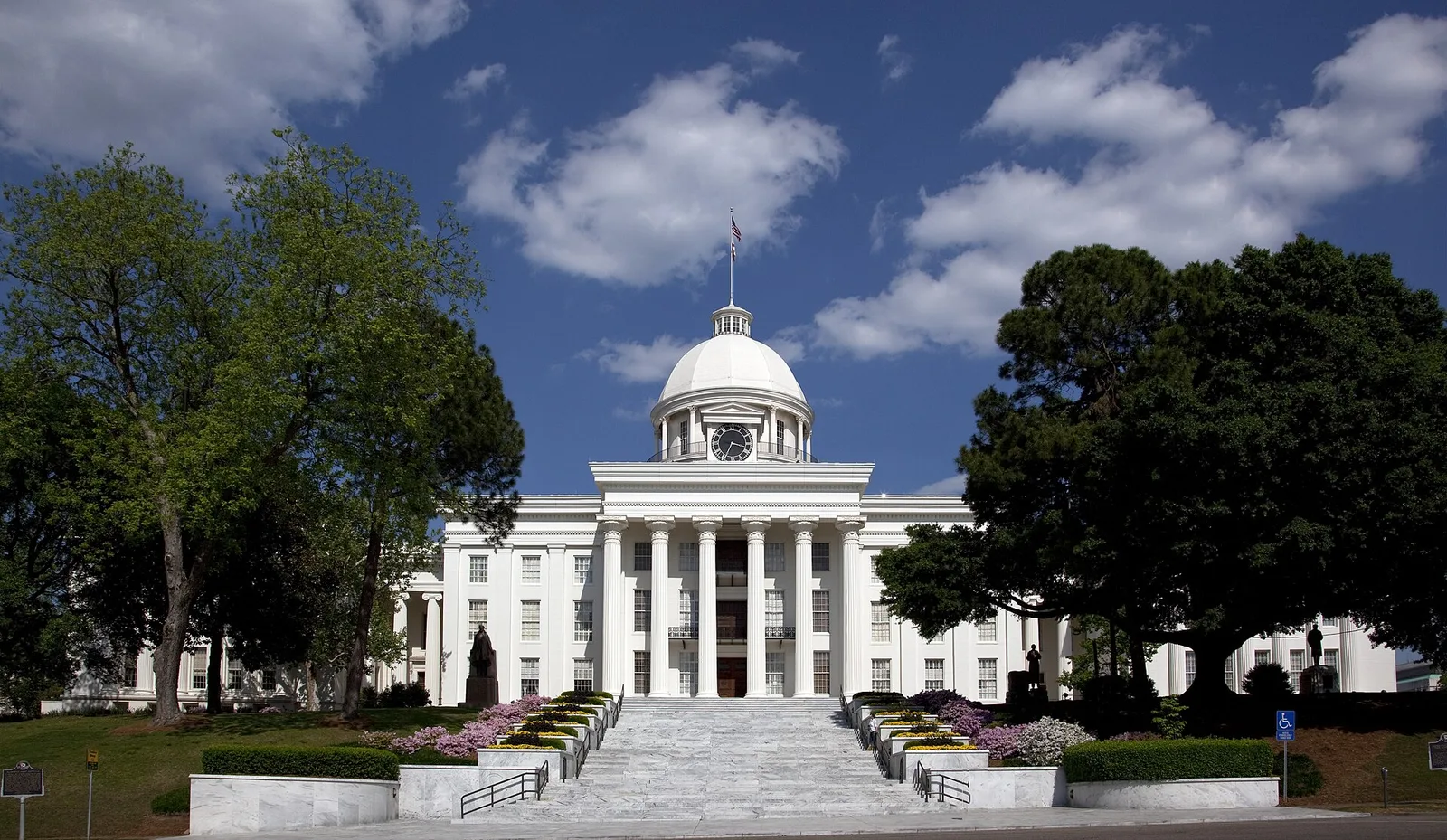
Montgomery was incorporated Dec. 3, 1819, and became Alabama's capital in 1846. Its 68 National Register listings, landmarks, museums and hours.
Last checked Oct. 17, 2026. Facts on this page come from the City of Montgomery’s About Montgomery and Facts About Montgomery pages, the Encyclopedia of Alabama’s Montgomery entry, the National Park Service’s National Register data (May 22, 2026 release), and each museum’s own site.
Montgomery was incorporated on Dec. 3, 1819, the city says, when two of the river settlements founded in 1817 and 1818 merged; it was named for Gen. Richard Montgomery, a Revolutionary War hero. It became the county seat in 1822 and Alabama’s capital in 1846. The city holds 68 listings on the National Register of Historic Places. For tours of Oakwood Cemetery, call the city at 334-240-4630.
Who to call
- Alabama Department of Archives and History and the Museum of Alabama: 334-242-4435; tours 334-242-4364
- Freedom Rides Museum: 334-414-8647
- Oakwood Cemetery tours and inquiries: 334-240-4630 or 334-240-4494
- City historic preservation coordinator: 334-625-2041
How Montgomery began
- 1817 and 1818: three small settlements spring up on the banks of the Alabama River.
- 1819: two of them merge to form Montgomery; the city dates its incorporation to Dec. 3, 1819.
- 1822: Montgomery becomes the seat of Montgomery County.
- 1846: the legislature picks Montgomery as the state capital, helped by free land on Goat Hill, which town promoter Andrew Dexter had set aside at the east end of Market Street. Dexter Avenue is named for him.
- 1847: the first capitol is finished; it burns in December 1849. Its replacement, finished in 1851, is still the capitol.
- 1861: Montgomery hosts the convention that forms the Confederate States of America and serves as the provisional capital until May 1861, when the capital moves to Richmond, Virginia.
- 1886: the city gains fame for the first electric streetcar system in the Western Hemisphere.
- 1910: the Wright brothers run their first civilian flying school for three months west of town.
- Dec. 1, 1955: Rosa Parks is arrested for refusing to give up her bus seat, starting a yearlong boycott led by Ralph Abernathy, Martin Luther King Jr. and E.D. Nixon.
- 1965: the Selma to Montgomery March for voting rights ends at the capitol.
The historic downtown
The capitol on Goat Hill looks down Dexter Avenue to Court Square and its fountain, the heart of the Court Square Historic District (listed 1982, enlarged 1984 as Court Square-Dexter Avenue). Toward the river, the Lower Commerce Street Historic District (1979, enlarged 1982 and 1987) and Montgomery Union Station and Trainshed (1973) frame the riverfront.
National Register of Historic Places listings
Every listing with a Montgomery address in the National Park Service’s National Register data, by year listed. Five are also National Historic Landmarks. Three archaeological sites have restricted addresses. Boundary increases to existing districts are not listed separately.
| Listed | Property | Address |
|---|---|---|
| 1966 | Alabama State Capitol (National Historic Landmark) | Goat Hill, east end of Dexter Avenue |
| 1971 | Ordeman-Shaw Historic District | Bounded by McDonough, Decatur, Madison, and Randolph Sts. |
| 1971 | Perry Street Historic District | McDonough, Sayre, Washington and Donaldson streets |
| 1972 | Winter Building | 2 Dexter Ave. |
| 1972 | The Murphy House | 22 Bibb St. |
| 1972 | Governor’s Mansion | 1142 S. Perry St. |
| 1972 | Semple House | 725 Monroe St. |
| 1973 | Powder Magazine | End of Eugene St. |
| 1973 | Edgewood | 3175 Thomas Ave. |
| 1973 | Montgomery Union Station and Trainshed (National Historic Landmark) | Water St. |
| 1973 | Muklassa | Address Restricted |
| 1973 | William Lowndes Yancey Law Office (National Historic Landmark) | Adams and Perry Sts. |
| 1974 | First White House of the Confederacy | 644 Washington Ave. |
| 1974 | Dexter Avenue Baptist Church (National Historic Landmark) | 454 Dexter Ave. |
| 1975 | St. John’s Episcopal Church | 113 Madison Ave. |
| 1975 | Gay House | 230 Noble Ave. |
| 1976 | Opp Cottage | 33 W. Jefferson Davis Ave. |
| 1976 | Cassimus House | 110 N. Jackson St. |
| 1976 | Cottage Hill Historic District | Roughly bounded by Goldthwaite, Bell, Holt, and Clayton Sts. |
| 1977 | Dr. C.A. Thigpen House | 1412 S. Perry St. |
| 1978 | Gov. Thomas G. Jones House | 323 Adams Ave. |
| 1978 | Jere Shine Site | Address Restricted |
| 1979 | Harrington Archaeological Site | Address Restricted |
| 1979 | Steiner-Lobman and Teague Hardware Buildings | 184 and 172 Commerce St. |
| 1979 | Jefferson Davis Hotel | Catoma and Montgomery Sts. |
| 1979 | Tulane Building | 800 High St. |
| 1979 | Lower Commerce Street Historic District | Roughly bounded by RR tracks, Commerce, N. Court, and Bibb Sts. |
| 1979 | Tyson-Maner House | 469 S. McDonough St. |
| 1979 | Stay House | 631 S. Hull St |
| 1979 | Patrick Henry Brittan House | 507 Columbus St. |
| 1980 | Gerald-Dowdell House | 405 S. Hull St. |
| 1980 | Brame House | 402-404 S. Hull St. |
| 1980 | McBryde-Screws-Tyson House | 433 Mildred St. |
| 1981 | Scott Street Firehouse | 418 Scott St. |
| 1981 | Bell Building | 207 Montgomery St. |
| 1982 | Sayre Street School | 506 Sayre St. |
| 1982 | Court Square Historic District | 21-35 Court St., 1-2 Dexter Ave., 18-24 N. Court St., and Court Sq. |
| 1982 | Pepperman House | 17 Mildred St. |
| 1982 | Dexter Avenue Baptist Church Pastorium | 309 S. Jackson St. |
| 1984 | Jefferson Franklin Jackson House | 409 S. Union St. |
| 1984 | South Perry Street Historic District | Roughly Perry St. between Washington St. and Dexter Ave. |
| 1984 | Garden District | Norman Bridge Road, Court Street, Jeff Davis and Fairview avenues |
| 1985 | Smith-Joseph-Stratton House | 302 Alabama St. |
| 1985 | Cloverdale Historic District | Norman Bridge and Cloverdale roads, Fairview and Felder avenues |
| 1986 | Shepherd Building | 312 Montgomery St. |
| 1988 | Building 800-Austin Hall | Second St., Maxwell AFB |
| 1988 | Building 836-Community College of the Air Force Building | Maxwell Blvd., Maxwell AFB |
| 1988 | Maxwell Air Force Base Senior Officer’s Quarters Historic District | Maxwell Air Force Base |
| 1988 | Dowe Historic District | 320 and 334 Washington Ave. and 114-116 S. Hull St. |
| 1990 | City of St. Jude Historic District | 2048 W. Fairview Ave. |
| 1991 | Old Ship African Methodist Episcopal Zion Church | 483 Holcombe St. |
| 1998 | United States Post Office and Courthouse-Montgomery (National Historic Landmark) | 15 Lee St. |
| 1998 | Alabama State University Historic District | 915 S. Jackson St. |
| 2000 | Huntingdon College Campus Historic District | 1500 E. Fairview Ave. |
| 2001 | Cleveland Court Apartments | 620-638 Cleveland Ct. |
| 2001 | Stone Plantation | 5001 Old Selma Rd. |
| 2002 | Mt. Zion AME Zion Church | 467 Holt St. |
| 2006 | Winter Place | 454 S. Goldwaite St. |
| 2011 | Montgomery Greyhound Bus Station | 210 S. Court St. |
| 2012 | Montgomery Veterans Administration Hospital Historic District | 215 Perry Hill Rd. |
| 2013 | Grove Court Apartments | 559 S. Court St. |
| 2016 | Wharton-Chappell House | 1020 Maxwell Blvd. |
| 2020 | Bricklayers Hall | 530 South Union St. |
| 2024 | Centennial Hill Historic District | Highland and Adams avenues to Hall Street and I-85 |
| 2024 | First Baptist Church | 347 N. Ripley St. |
| 2024 | Moore Building | 217 S. Court St. |
| 2024 | Court Square Urban Renewal Area Historic District | Madison Avenue, N. Lawrence, Church and Lee streets |
| 2025 | Peacock Tract Historic District | Bounded generally by Day Street, Rosa L. Parks Avenue, Early Street and I-65 |
Museums, memorials and cemeteries
| Place | Address | Hours as published |
|---|---|---|
| Alabama Department of Archives and History and the Museum of Alabama | 624 Washington Ave., across from the capitol | 8:30 a.m. to 4:30 p.m. Monday through Saturday; closed state holidays |
| Freedom Rides Museum, in the former Greyhound station | 210 S. Court St. | 11 a.m. to 4 p.m. Tuesday through Friday; 10 a.m. to 4 p.m. Saturday; last entry 3 p.m. |
| The Legacy Museum | 400 N. Court St. | 9 a.m. to 6 p.m. Wednesday through Monday; closed Tuesday; last entry 5 p.m. |
| National Memorial for Peace and Justice | 417 Caroline St. | 9 a.m. to 6 p.m. Wednesday through Monday; closed Tuesday; last entry 5:30 p.m. |
| Oakwood Cemetery | City of Montgomery | Tours by arrangement: 334-240-4630 |
The Legacy Sites close at 5 p.m. from Nov. 1 to Feb. 28 and are closed on Thanksgiving, Christmas and New Year’s Day; one ticket covers the Legacy Museum, the National Memorial, the Freedom Monument and Montgomery Square. Freedom Rides Museum admission is $5 for adults, and the outdoor exhibit is always open. The Archives’ research room is open Tuesday through Saturday. Other attractions the Encyclopedia of Alabama lists include the living-history museum Old Alabama Town, the Hank Williams Museum, the Scott and Zelda Fitzgerald Museum and the W.A. Gayle Planetarium; check each one’s hours before you go.
What this means for you
- Start at the capitol end of Dexter Avenue; the Archives museum is across the street, open Monday through Saturday.
- The Legacy Sites switch to 5 p.m. closing on Nov. 1.
- Researching a house? Ask the city’s historic preservation coordinator, 334-625-2041.
More guides: population, parks and trails and things to do this month.
Frequently asked questions
When was Montgomery, Alabama, founded?
Settlements grew up on the Alabama River in 1817 and 1818, and two of them merged in 1819 to form Montgomery. The city gives its incorporation date as Dec. 3, 1819.
When did Montgomery become the capital of Alabama?
In 1846, when the legislature chose it over Tuscaloosa. The first capitol on Goat Hill was finished in 1847 and burned in December 1849; the building that replaced it, finished in 1851, is still the capitol.
How many National Register of Historic Places listings are in Montgomery?
68 listings with a Montgomery address in the National Park Service’s National Register data, from the Alabama State Capitol in 1966 to the Peacock Tract Historic District in 2025. Five are also National Historic Landmarks.
What are the Legacy Museum’s hours?
9 a.m. to 6 p.m. Wednesday through Monday, closed Tuesday, with last entry at 5 p.m. From Nov. 1 to Feb. 28 the Legacy Sites close at 5 p.m.
Is the Freedom Rides Museum open on weekends?
On Saturday, 10 a.m. to 4 p.m. It is open 11 a.m. to 4 p.m. Tuesday through Friday, with last entry at 3 p.m., at 210 S. Court St.
Have your say