
City of Montgomery property is taxed at 48.5 mills. Taxes are due Oct. 1 and delinquent after Dec. 31. Revenue Commissioner: 334-832-1250.
Last checked Oct. 17, 2026. Facts on this page come from the Montgomery County Appraisal Department, its appeals and appeals FAQ pages, the county’s frequently called numbers, the Revenue Commissioner’s citizen access portal, the Alabama Department of Revenue’s property tax FAQ and its October 2024 millage table (PDF).
In Montgomery County one elected office, the Revenue Commissioner, values property, grants exemptions, bills and collects the tax. Revenue Commissioner Janet Buskey’s office is at 101 S. Lawrence St., phone 334-832-1250. Statewide, property taxes are due Oct. 1 and delinquent after Dec. 31. Look up your parcel, value and bill on the county’s citizen access portal.
Who to call
- Revenue Commissioner (bills, payments, exemptions): 334-832-1250, 101 S. Lawrence St.
- Appraisal Department front desk (your property’s value): 334-832-1303, 125 Washington Ave.
- Real property appeals: 334-832-1327, propertytaxappeals@mc-ala.org
- Business personal property appeals: 334-832-1375
- Alabama Department of Revenue: 334-242-2677
Due dates
- Oct. 1: property taxes for the tax year are due.
- Dec. 31: the last day before taxes become delinquent.
- About April 15: the Appraisal Department mails valuation notices; 2026 notices were scheduled for on or about April 15, 2026. Owners whose property is exempt need take no action.
The state is clear that the Revenue Commissioner does not have to mail a tax notice and sends one only as a courtesy. If no bill arrives, you still owe the tax; look it up on the portal or call 334-832-1250.
The rate inside the city
Alabama taxes property in mills: one mill is one-tenth of a cent, or $1 for every $1,000 of assessed value. The Alabama Department of Revenue’s latest published table, for the October 2024 levy, puts property inside the City of Montgomery at 48.5 mills:
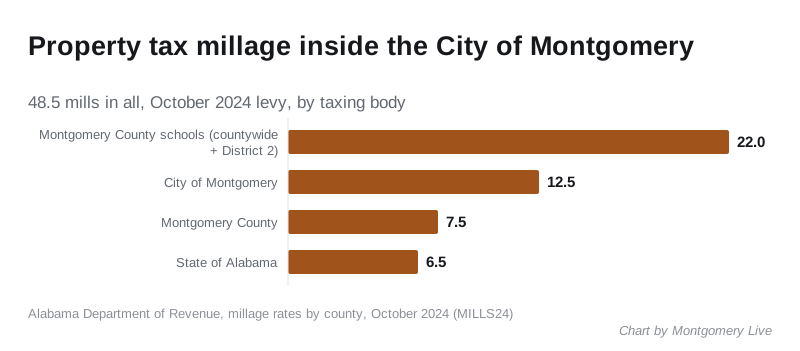
| Taxing body | Mills |
|---|---|
| State of Alabama (schools, soldier fund, general fund) | 6.5 |
| Montgomery County (general fund, road and bridge) | 7.5 |
| Schools (3.5 countywide plus 18.5 for District 2, Montgomery) | 22.0 |
| City of Montgomery | 12.5 |
| Total inside the city | 48.5 |
Outside the city and Pike Road, the county adds 5 mills for fire protection. Inside the Town of Pike Road the total is different, because Pike Road levies 26 mills of its own and its school district carries 29.
How the bill is figured
The state’s formula: appraised value, times the assessment rate (10% for an owner-occupied home), times the millage. The Census Bureau’s median value for an owner-occupied Montgomery home is $161,900 (2020-2024 American Community Survey). At 48.5 mills, that home’s tax before any exemption works out like this:
- $161,900 x 10% = $16,190 assessed value
- $16,190 x 0.0485 = about $785 a year, before exemptions
Your bill will differ with your value and exemptions. The 7% cap on annual increases in assessed value under Act 2024-344 is explained on the state’s page.
Homestead exemption
A homestead is a single-family, owner-occupied home and up to 160 acres. You may qualify if you own the home and live in it as your main residence on the first day of the tax year (Oct. 1). Homeowners 65 or older, the permanently and totally disabled and the blind are exempt from the state portion of the tax; county taxes may still be due. Apply in person with the Revenue Commissioner (334-832-1250); the state’s homestead exemptions page lists the types.
How to appeal your value
- Watch for the valuation notice. It is mailed when your property’s value changes.
- File within 30 days of the date printed on the notice, online through the citizen access portal or by email to propertytaxappeals@mc-ala.org. No special form is needed and there is no fee.
- Send your evidence with the appeal: closing statements, recent appraisals, photos, comparable sales or insurance values. The board wants every document with the filing.
- Informal review first. The Appraisal Department tries to settle it. If it cannot, ask for a formal hearing before the Board of Equalization.
The county values property one year in arrears: a tax year’s value reflects the property as of Oct. 1 of the year before. If you add or tear down a building, tell the Appraisal Department so the record is right.
What this means for you
- Pay by Dec. 31 to avoid delinquency, bill or no bill.
- Bought a home this year? Claim your homestead exemption with the Revenue Commissioner.
- Valuation notice looks high? You have 30 days from its date.
More guides: home prices, moving to Montgomery and who to call at City Hall.
Frequently asked questions
When are Montgomery County, Alabama, property taxes due?
Alabama property taxes are due Oct. 1 and are delinquent after Dec. 31, according to the Alabama Department of Revenue. You owe the tax whether or not you get a bill in the mail.
What is the property tax rate in the City of Montgomery?
48.5 mills on the October 2024 levy, the latest state table: 6.5 state, 7.5 county, 22 school and 12.5 city. One mill is $1 for each $1,000 of assessed value.
Who do I call about my Montgomery County property tax bill?
The Montgomery County Revenue Commissioner, Janet Buskey, at 334-832-1250, 101 S. Lawrence St. Questions about your property’s value go to the Appraisal Department at 334-832-1303.
How do I appeal my property value in Montgomery County?
File within 30 days of the date printed on your valuation notice, online through the county’s citizen access portal or by email to propertytaxappeals@mc-ala.org, with evidence such as a closing statement or appraisal. There is no fee. Real property appeals: 334-832-1327.
Do seniors pay property tax in Alabama?
Homeowners 65 and older, the permanently and totally disabled, and the blind are exempt from the state portion of property tax, but county taxes may still be due. Claim the homestead exemption with the Revenue Commissioner.
Have your say